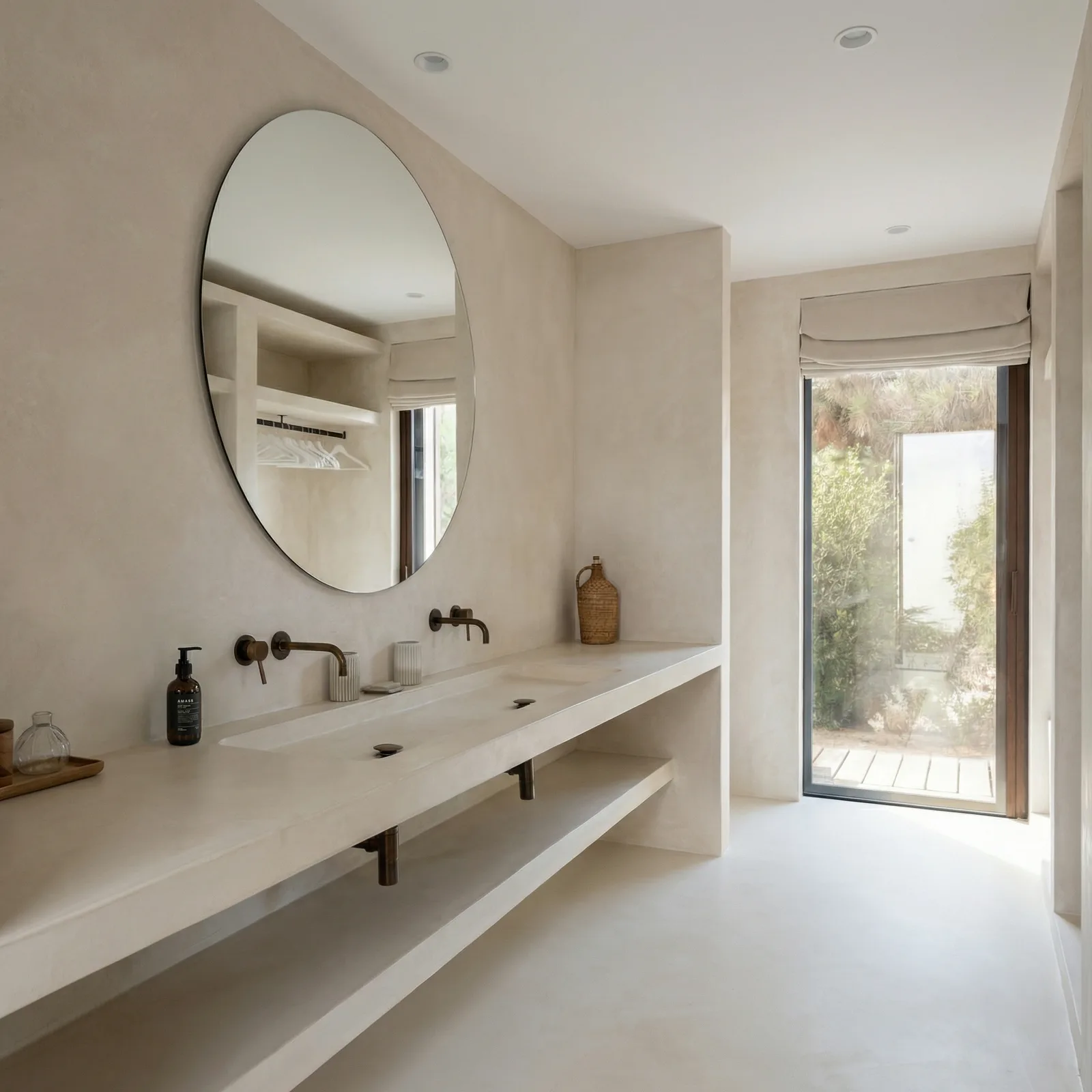
If Tadelakt is the organic, soulful choice for wall finishes, Microcement is its sleek, resilient, and modern counterpart. In the drive for minimalism and continuous, unbroken lines, Microcement has emerged as the ultimate problem-solver for contemporary renovations. It bridges the gap between the raw, industrial look of concrete and the refined comfort of a home, offering a durability that few other decorative finishes can match.


What is Microcement?
Microcement is a composite coating based on cement, water-based resins, additives, and mineral pigments. Unlike standard concrete - a structural material poured in thick slabs - Microcement is a decorative layer applied very thinly: usually only 2 to 3 millimeters thick.
The magic lies in the polymers (resins) mixed into the cement.


The Science of Flexibility
Standard cement is rigid and prone to cracking. The polymers (resins) mixed into Microcement give it high flexibility and tensile strength, allowing it to withstand movements and vibrations without cracking. This makes it suitable for surfaces where traditional concrete would fail.
The Adhesion Factor
Microcement creates an incredibly strong chemical and mechanical bond with almost any substrate. It can be applied directly over drywall, wood, marble, and existing tile. This "stick-to-anything" quality makes it a renovation hero - you rarely need to demolish the existing surface before applying it.


Where Can You Use Microcement?
While Tadelakt is the master of wet rooms and walls, Microcement is the master of high-traffic areas and what might otherwise be "impossible" renovations.
Seamless Flooring
This is the most common use for Microcement. It allows you to cover an entire ground floor - from the living room into the kitchen and hallway - without a single break or threshold. It is highly resistant to abrasion and impact, making it ideal for households with pets or children.
Kitchen Worktops & Work Surfaces
Microcement is hard enough to be used as a work surface. When properly sealed with a polyurethane topcoat, it becomes resistant to heat, water, and stains. Like natural stone, avoid leaving acidic spills (lemon juice, vinegar) for extended periods.
Exterior Applications
Unlike gypsum or lime plasters, specific formulations of Microcement are designed for exterior use. It can pave patios, coat outdoor walls, and create a continuous visual flow from the interior of the house to the garden.


Microcement vs. The Competition
Microcement is often confused with other industrial-style floorings. Here is how it differentiates itself.
| Finish | Look | Water Resistance | Best For |
|---|---|---|---|
| Microcement | Industrial, seamless, matte-satin. Available in any color. Natural mineral appearance. | Excellent when sealed with a polyurethane topcoat. UV stable — will not yellow. | Floors, worktops, high-traffic areas. Both wet and dry rooms. |
| Polished Concrete | Structural concrete ground to a high shine. Aggregate exposure is unpredictable. | Requires sealing. Prone to hairline cracking over time. | Ground-floor slabs only. Heavy — often impossible on upper floors. |
| Tadelakt | Organic, wavy surface. Deep earthen tones with subtle variation. | Naturally waterproof. The lime-soap reaction is built in — no sealer needed. | Shower walls, wet rooms, barefoot areas. Can scratch under heavy furniture. |
| Epoxy Resin | High-gloss, often "plasticky". Many epoxies yellow in sunlight. | Fully waterproof synthetic coating. | Industrial floors and garages. Less suited to warm residential interiors. |


The Verdict
Microcement offers the perfect balance of industrial aesthetic and domestic practicality. It provides the coveted "concrete look" without the logistical challenge of pouring heavy structural slabs. Its ability to cover existing surfaces makes it a sustainable choice for renovations, reducing waste and labor. For homeowners seeking a continuous, joint-free architecture that feels modern yet warm, Microcement is the defining material of the decade.